
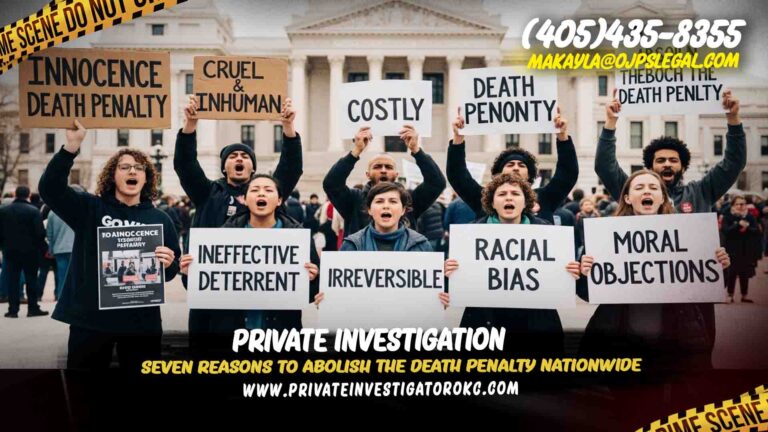
Death penalty private investigators study cold trial records, buried evidence, and wrongful convictions on a daily basis. They witness the dangers of imperfect investigations, hasty prosecutions, and prejudiced systems that put innocent people on death row. This experience makes a lot of investigators strong enemies of capital punishment. In this blog, there are seven reasons the death penalty private investigator thinks it is time to abolish the death penalty nationwide. Each reason derives from realities that investigators discover as they work side by side with defense lawyers, families, and exonerees.
Table of Contents
Risk For Executing Innocent People
A death sentence assumes that the investigation and trial of a case were correct. However, what death penalty private investigators know is that serious errors occur. New witnesses come forward, forensic science improves, and hidden documents come to light years later. DNA testing alone has exonerated several people who were once facing the sentence of execution. When the system kills someone, then no one can repair or reverse that mistake. As long as there are wrongful convictions, the death penalty is an unacceptable risk.
Deep Racial And Class Bias
Death penalty private investigators can observe definite patterns if they study old cases. Courts more often sentence defendants of color, especially Black defendants, to death than they sentence white people who face similar charges. Poor defendants with underfunded counsel are also more at risk than wealthy defendants. Juries and prosecutors react differently to victims being white as opposed to Black or Brown. These patterns reveal that capital punishment does not fall only on “the worst crimes” but on the least powerful people. No one can describe a form of punishment that targets race and poverty as fair and just.
Serious Investigative And Forensic Mistakes
Investigators often find major flaws in homicide investigations that at one time seemed airtight. Police sometimes use forged confessions, unreliable jailhouse informants, or mistaken eyewitness identifications. In others, obsolete forensic techniques (e.g., bite-mark analysis, unproven theories also in arson) played central roles. When a death penalty private investigator reconstructs death penalty cases, the evidence often looks quite different than how it did originally to the jurors. Capital punishment takes every mistake in the investigation and makes a life-or-death decision out of just one bad lab test or one rushed interview.
Ineffective As A Deterrent To Crime
Supporters often argue that the death penalty is a deterrent to murder more than long sentences in prison. A death penalty private investigator does not see such an effect as he or she reviews the patterns of crime. Many homicides occur in the heat of the moment, in a state of rage, fear, or intoxication, in which the offender is not considering the legal ramifications of their action with great thought. Others involve people who believe that no one will catch them at all. States without the death penalty often have equal or lower murder rates than states that operate with the death penalty. If you have a punishment that does not obviously deter crime, its retention is only going to add cruelty on top of no safety.
Immense Influence On Taxpayer Dollars
Death penalty cases are far more expensive than cases without the death penalty from beginning to end. Capital trials involve additional lawyers, a longer jury selection process, and more expert witnesses. Appeals drag on for decades, with the need for investigators, transcripts, and repeated hearings. A death penalty private investigator’s work often takes months, as there is a lot at stake. Studies show that taxpayers would save a considerable amount of money if states replaced death sentences with life imprisonment without parole. States could use those funds to support victim services, crime prevention, and public defense instead.
Trauma For Victims And Their Families & Community
Many grieving families wish that the death penalty would provide closure. A death penalty private investigator often witnesses the opposite. Decades of appeals lead families to never give up on the case and force them to live their loss all over again. Execution dates often change, and this creates emotional whiplash. Some families later report that the lengthy process was a delaying factor in the process of true healing. Alternatives such as life imprisonment can still be a means of accountability without having to drag survivors through an endless court battle. Communities are better off when their resources keep supporting programs on counseling, memorials, and violence prevention programs in lieu of executions.
Global Human Rights And Moral Issues
Most democratic countries have already ended the death sentence. Human rights organizations have argued that killing by a state is not only a violation of basic dignity, but also a crime after terrible crimes. A death penalty private investigator who has seen botched executions or last-minute stays knows how much human cost there is. The responsibility to kill in the name of the public burdens guards, nurses, chaplains, and officials. When the state opts for life imprisonment instead, it stands to protect society, and at the same time, it does not suffer irremediable moral harm. Abolition would bring the United States closer to international human rights and modern values of justice.
Conclusion
Death penalty private investigators know that true justice must be accurate, fair, and humane. The possible risk of executing an innocent person, coupled with racial prejudice, mistakes in the investigation, the high cost, and the emotional damage, makes it clear that the death penalty has failed in all three counts. Nationwide abolition would not condone violent crime; it would replace unreliable but irrevocable punishment with alternatives that were safer. If you believe in the abolishment of wrongful convictions and/or you believe that the sentencing system is unfair, then you can support local innocence projects, public defenders, and reform organizations. Together, investigators, lawyers, and community members can balance the construction of a justice system that protects people without executing them.