
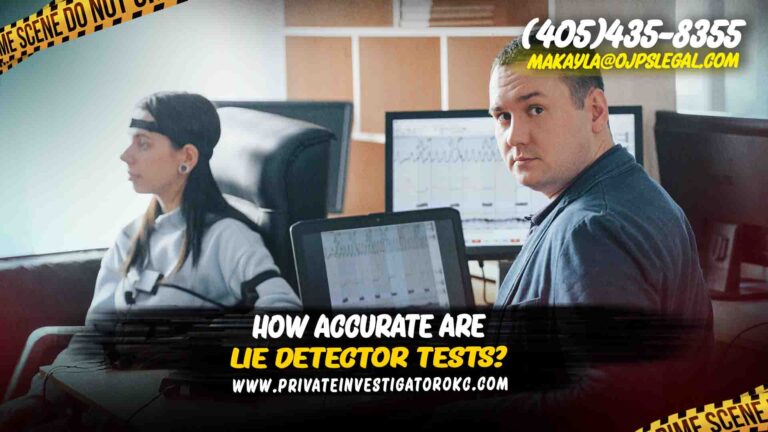
A polygraph is not a device that records deception. It measures your body’s physiological response as you answer a series of questions from an examiner. A polygraph could measure blood pressure and pulse rate, skin response, or your rate of breathing. However, your body can display physiological responses for numerous other causes apart from the act of telling untruths.
These feelings, such as stress, fear, anxiety, confusion, and embarrassment, can influence the body. However, this creates an inherent flaw in polygraph testing. Some single-incident polygraph tests are more accurate than chance, but the accuracy is still not perfect.
The difference above is something that people should understand before arranging for a lie detector test in OKC. A polygraph test can deliver some beneficial investigatory data, yet can not stand as an honest truth-finder machine.
Table of Contents
What Does A Lie Detector Actually Measure?
The polygraph actually charts levels of physical activity rather than detecting lying. During questioning about an event, the equipment records respiration patterns. It also records cardiovascular and electrodermal output. All of these stimuli would produce recorded output in the form of graphs for viewing.
Next, the examiner interprets the graphs based on the examination procedures. The principle used is that if a person is under psychological stress, their body has a response to the stimulus. A liar sometimes develops stress regarding detection, which triggers a physiological response. However, there are factors other than lying that are responsible for the physiological arousal. A truthful subject may very well become highly nervous during tests.
A person might fear losing a love interest or a job due to wrong accusations. These fears could have substantial physiological reactions. Hence, simply finding a lie-related reaction isn’t enough for the machine.
How Accurate Are Polygraph Tests?
There is no proof about what percentage accuracy a polygraph test achieves. The percentages will depend on the method of testing used, the type of question(s), the examiner, the conditions, and the people involved. Scientific reviews indicate that for specific-incident polygraphs, the likelihood of differentiating deception from truth can be greater than chance under particular circumstances.
Important drawbacks have also emerged. In contrast, a polygraph has not failed in a study. In addition, this statement does not cover most of the research. Percentages have value only if we know the methods of performing and calculating this research. A particular incident test also differs from a general screening. There are different implications and complications within each application.
Why Accuracy Claims Need Context
A test may work under standard controlled circumstances, and may work less well in practical terms. In research contexts, it’s possible to appropriately choose a sample group, making the methodology fairly tight. Investigations in the real world may involve emotionally charged arguments, murky information, complex relationships, and unpredictability. Also, how people react to these events will differ.
It’s difficult to extrapolate findings from one test to all real-world situations. It is possible that the accuracy of the polygraph correlates with the specific protocol. The circumstances of the testing and one particular result cannot necessarily prove accuracy in all testing contexts.
The contrast is particularly notable in terms of marketing assertions made by services. A service may list an amazing accuracy percentage but fail to detail the process of achieving this figure. When booking your Lie Detector Test OKC, inquire about the significance of the stated accuracy.
What Are False Positives and False Negatives?
A false positive occurs when the test incorrectly indicates that a deceptive decision is occurring, even though the subject is not, in fact, deceiving. This is because these physiological responses are not unique to deceit. For example, if an employee is held as a suspect of theft, even a guilty employee may display a high level of anxiety.
They might be concerned about their employment, and concerned people already assume the subject is guilty. They might also be angry about the questions, and all these feelings trigger changes in physiological response.
The polygraph graphs show changes in physiological response, but they do not reveal that deceit has occurred. It’s one of the key elements of professional examination of readings, and the examiner must look for the overall pattern.
A False Negative happens when someone is indeed trying to deceive you, but the test says they aren’t. People are not the same under stress, since some react physiologically very strongly. On the other hand, some may not even react that outwardly, and it is also a challenge.
Why Nervousness Does Not Equal Lying
The one myth related to the polygraph test is that if someone is nervous, they will fail the test. This should not be the way to conduct the polygraph test. People are nervous during a polygraph test due to the nature of the examination. It could be about lying in a relationship or under criminal investigation, and other personal problems they may not want to reveal.
An honest person, then, can exhibit a pronounced physiological response. The examiner has the ability to interpret this response contextually. On an examination, there is no need to make yourself believe you have an unswerving calm.
Why Calmness Does Not Prove Truthfulness
There is the idea that being calm automatically results in being successful in the answering process. A person can remain fairly calm and answer with a deceptive response. The examiner isn’t just looking for visual signs of nervousness, but also for changes in your physiological state.
It’s crucial to observe that these two are not the same, as appearance and physiological measurements are different. A person who is not agitated might nonetheless display a significant physiological change. Similarly, an agitated person might be telling the truth. The entire test, therefore, needs more observation.
The Importance Of Question Design
It is worth discussing question design at length in polygraph examinations. Questions should deal with concrete areas of investigation as opposed to vague value judgments on an individual’s character. For example, consider an investigation into stolen money. A precise question might be whether an individual has stolen $500.00 at such-and-such a time.
Precise questions define more targets, and they make it more viable for the examiner to conduct comparisons with physiological responses. It would not be possible for the examiner to form relevant questions in the pre-test stage without understanding the conditions.
Why The Pre-Test Interview Matters
The pre-test interview forms the basis of the test. The examiner explains the purpose of the test and obtains the details of the problem. The questions relevant to the problem have been gone through with the examinee. Then they clarify ambiguities before administering the test. It’s also possible to clarify conditions that could influence the test during the interview.
The examiner could find out that the question concerns the death of a family pet occurring in emotionally taxing circumstances. Knowledge like that can factor in when considering someone’s physiological answers to a lie detector. A proper Lie Detector Test in Oklahoma City really needs more than wires, questions, and answers.
Why The Testing Environment Matters
The testing environment may affect physiological reactions. Physical stimuli, like noise, lack of privacy, non-optimal temperatures, movement of surroundings, and numerous other factors, are distracting factors. They do not need to be present and may lead to artifactual variations. Examiners should attempt to conduct tests in their ideal state, if possible.
However, this doesn’t make the test foolproof, just a bit better at removing variables that might mess up the data. If you are scheduling a Lie Detector Test in OKC, ask how and where the examination will be taking place. Also, ask if you will be in the right setting.
The Examiner Is Part Of The Accuracy Equation
It’s only one half of the examination since an examiner needs to ask the relevant questions and conduct an interview. Then use the machine appropriately and make sense of the recorded response. It means training/experience matters, as a state-of-the-art machine cannot compensate for bad questions/ examination.
When choosing a provider, ask them about their professional training and professional experience. Ask the examiner how they deal with complex cases or when there are ambiguous results. A professional provider should detail the capabilities and limitations of the polygraph test rather than guaranteeing their results.
Specific-Incident Tests Versus Screening
The type of test can have an impact on the accuracy of the test. A specific-incident test involves verifying a particular known situation or event. For example, an investigation could test whether someone stole money on a particular occasion. Screening tests are less detailed. So, they try to establish any undisclosed behavior, but do not seek to confirm anything about a specific event.
Science-based reviews have also suggested a higher level of uncertainty associated with applications of the test to screening. You cannot, therefore, take accurate data from a particular incident to hold true in general screening applications. The reason for performing the test is what should lead one to consider performing it in the first place.
Can Medications and Physical Conditions Affect Polygraph Results?
All substances and physical factors affect your physiology to some degree. This in itself will not preclude you from undertaking a polygraph. You should make reference to any factors involved before the testing is undertaken. The operator can decide whether it would be necessary to take any further action.
Do not discontinue medication because of an examination without approval. Report and do not start/stop any prescription medication without your doctor’s instruction. Full information given on the circumstances allows a more educated response from the examiner.
Physical conditions may influence the measures of physiology. Pain, the response to labored breathing, the impact of the cardiovascular system, and other conditions may influence the measurement obtained.
Can a polygraph prove innocence and Guilt?
While a “passing” polygraph result could be evidence of truth, that does not translate to being an “innocent” statement. It only relates to the questions being asked. However, it does not prove that every statement made by an individual to the police is a lie.
It can be necessary to review documents, communications, financial records, witness accounts, observations, etc. Should a formal procedure take place, lawyers will be able to advise you on how these outcomes may be utilized. A polygraph is able to furnish information, and it shouldn’t form the basis for your decision.
The reverse is also true, since a lie-indicator result is no guarantee of guilt in law. What is tested is physiological responses under a defined methodology. There are a myriad of reasons for the measured responses. All factors must be weighed together by the court in light of the evidence and the law. That is why the polygraph should never be considered a sentencing decision.
Why Polygraphs Remain Controversial
It’s unclear whether polygraphs would ever be generally accepted, largely due to what they measure. It is very real, but an indirect measure of anything, and the polygraph machines do indeed measure real physical activity. It’s the reason for it that’s questionable. Critics claim that there is research out there to say that some specific-incident methods are above chance.
They have pointed out that the measurements are not restricted to deception, and there is still potential to make mistakes. This is also the reason why the responsible debate does not characterize the polygraph as flawless. The correct estimation is in between: With certain requirements, polygraphs can be an informative tool, but they have some clear deficiencies.
Does A Higher Price Mean Greater Accuracy?
More expensive doesn’t always equal better quality, and price doesn’t always correspond with scientific accuracy. The fee could represent anything from travel costs, report writing, and follow-up consultation time to the time taken for the examination.
When evaluating Lie Detector Test Oklahoma City providers, pay close attention to the qualifications and procedure of the examiner, and be sure to find out what is included in the fee, how the test would be conducted, and if results will be reported, because these facts are more relevant than a highly priced statement.
How To Interpret Accuracy Claims Responsibly
If you ever see an accuracy percentage being quoted, always question it. Ask what form of testing led to the figure. Determine if the number represents the result of laboratory findings, field findings, or internal claims by a provider. Determine if failed or inconclusive results were included.
Ask if the target population tested is comparable to yours. If not, then such a percentage could give you false confidence. It requires more than a statistic.
Final Thoughts
How accurate are lie detector tests, then? As such, there is no single percentage that could be given to all polygraph tests. While evidence does exist for particular incident-specific examinations being capable of differentiating between lies and the truth at a rate higher than chance, reviews have noted several constraints on performance.
Polygraphs do not detect lies, but they detect changes in biological responses. Physiological responses can be affected by stress, nervousness, anxiety, fear, sickness, drug effects, and so forth. A nervous nature does not necessarily equal lying behavior. An appearing-calm nature does not necessarily equal truth-telling either.
If you are considering a Lie Detector Test in Oklahoma City, research the provider carefully. Ask about qualifications, testing methods, question design, reporting, pricing, and the limitations of the examination.